
Quick read
Sinkholes in Australia form when the ground loses support beneath the surface, usually because water has dissolved rock or carried soil into an underground space. Not every sudden hole is a true sinkhole, though. Many are washouts, settling fill or another form of subsidence, and each needs a different repair.
Your first priority is to keep people away from the hole and have the cause assessed before anyone fills it.
What is a sinkhole, and how are sinkholes formed?
A sinkhole is a depression or opening that appears when surface material drops into a space below it. Water dissolves soluble rock or washes fine soil away, an underground void grows, and the surface above eventually settles or collapses into it. That can happen slowly over years, or overnight once the roof of the void can no longer carry its own weight.
| Ground problem | What is happening | Typical clue |
|---|---|---|
| Sinkhole | Ground drops into an underlying cavity | A distinct depression or opening |
| Subsidence | Ground settles over a broader area | Uneven floors or cracks in the building |
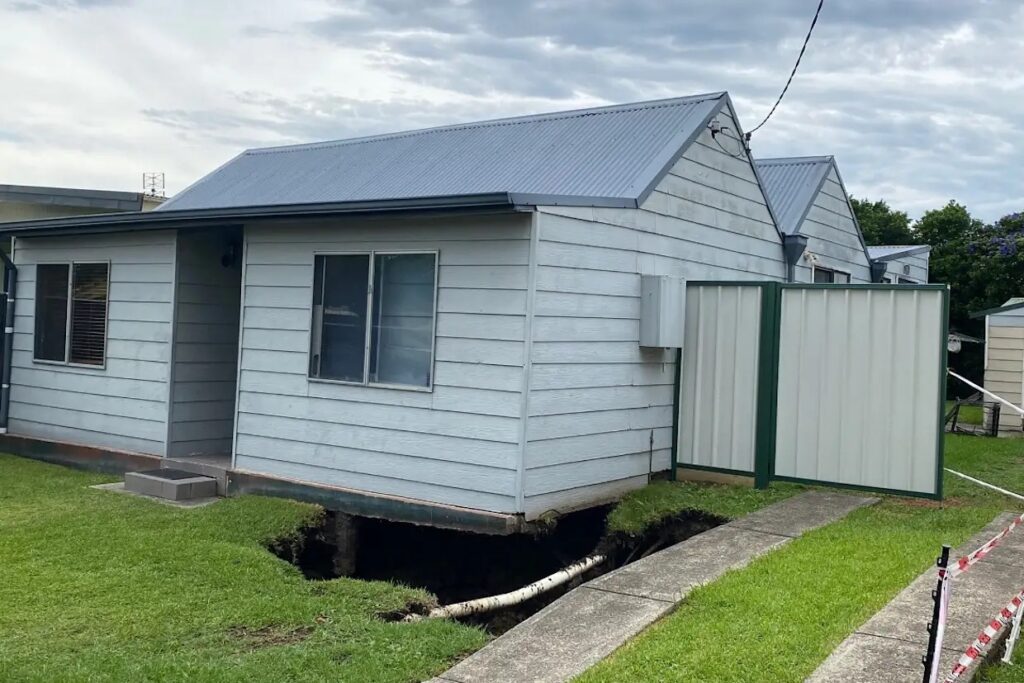
| Washout | Flowing water removes soil, as with a washout beneath a house | Appears near drainage, pipes or culverts |
What causes sinkholes in Australia?
Natural sinkholes are tied to karst country. Geoscience Australia explains how karst forms: slightly acidic groundwater slowly dissolves limestone, opening caves and cavities. Australia’s best-known limestone landscapes include the Nullarbor Plain and parts of South Australia and Western Australia, though not every property there is at risk.
Old mining is a second cause. Abandoned workings around Newcastle, the Hunter and Ipswich left tunnels that can give way decades later, a problem known as mine subsidence.
On suburban blocks, the usual culprits are poorly compacted fill and water. Fill settles under its own weight, while leaking pipes, broken stormwater lines and runoff wash fine soil away, leaving voids under slabs, paths and driveways. On 99 homes we repaired after a void enquiry, crews recorded weak or poorly compacted fill on 56%, poor drainage on 44%, water running through the site on 39% and tree roots on 24%. Only 1 in 5 had no obvious cause, against 1 in 3 of our other jobs.
Where do we see the most sinkhole and void enquiries?
About 1 in 20 enquiries Resinject receives is about a void, sinkhole or washout: 935 between July 2023 and June 2026. Queensland accounts for just over a third of our enquiries but half of our void enquiries.
| Region | Share of the region’s enquiries about voids |
|---|---|
| Sunshine Coast | 8.7% |
| Gold Coast | 7.6% |
| Brisbane | 7.4% |
| Greater Sydney | 3.7% |
| Canberra and Southern NSW | 3.1% |
Brisbane’s share is rising, from 6.4% in FY24 to 7.9% in FY26.
Warning signs and what to do if a hole appears
Signs worth checking early
- New dips, soft patches or sunken areas in lawns and paving
- Fresh cracks in paths, driveways or walls, or concrete that has started to sink
- Doors and windows that suddenly jam
- Water pooling where it never did before, or draining away unusually fast
Take these steps before anyone approaches the opening
- Keep people, pets and vehicles well clear. Don’t stand at the edge or probe the hole.
- Call 000 if people, a building or a public road are at immediate risk. Report suspected leaking mains or sewers to your water utility, and holes on public land to the local council.
- In a NSW mine subsidence district, report it to Subsidence Advisory NSW on its 24-hour line, 1800 248 083.
- Book an assessment with a qualified ground specialist, and fix any water source before choosing a repair.
- Don’t tip in loose soil or concrete. It hides a continuing void without restoring support.
How is a sinkhole repaired?
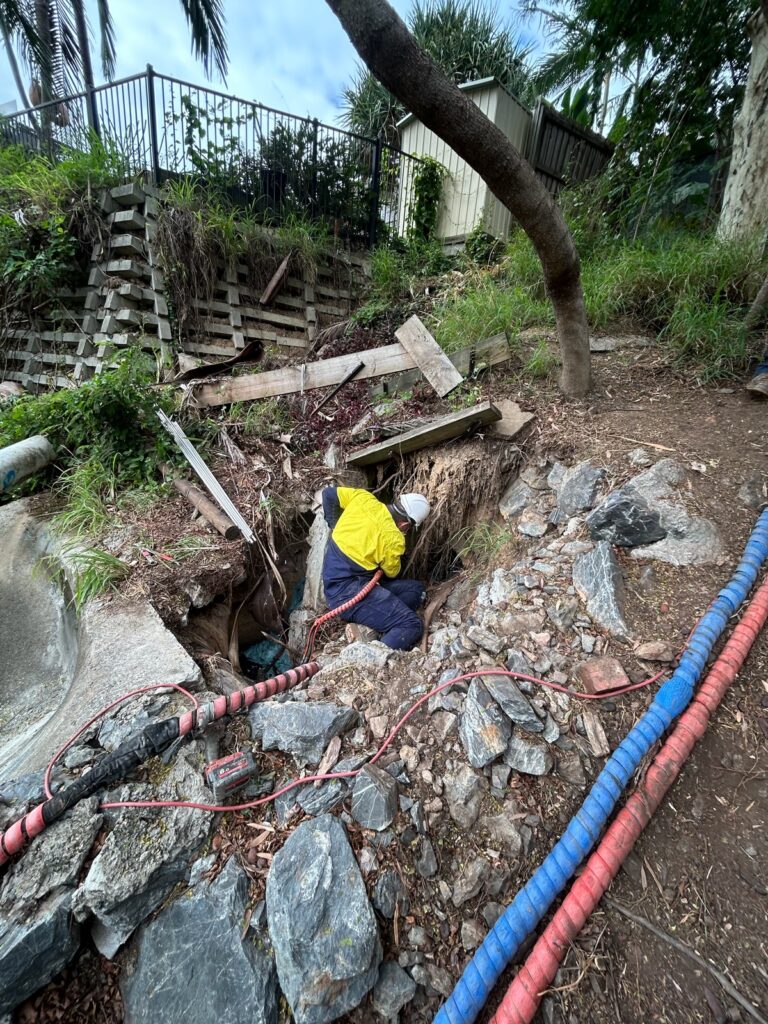
Sinkhole repair depends on the cause, the size and depth of the void, groundwater, and how close the hole sits to structures or services.
| Method | Where it may suit | Key consideration |
|---|---|---|
| Dig out and backfill | Accessible, shallow, localised holes | Needs excavation and proper compaction |
| Cement grout | Some deeper voids | Placement and ground conditions need engineering assessment |
| Expanding resin | Assessed voids or weakened ground beneath slabs, driveways and infrastructure | Injected through small holes with minimal excavation, as used in void filling |
| Piles | Structures needing load transferred to deeper, competent ground | Larger engineered works |
Expanding resin is Resinject’s specialty. After a site assessment, our certified, Australian-made RSJ170 resin is injected to fill suitable voids and densify weakened soil. It complies with the Roads & Maritime Services M232 specification for injected expanding resin, is engineered to lift more than 90 tonnes per square metre and carries a 50-year product warranty. Through deep ground injection, it reaches depths from 800 mm to 6.5 m. Any underlying leak has to be fixed too, or water will keep moving soil.
What Resinject’s ground-void projects show
Remediation of a washed-out road: storms blocked two culverts under a council road, forcing stormwater through the subsoil. The washout opened two sinkholes, cutting off the only access to five homes. Resinject’s emergency crew re-supported the road with deep resin injection in a single 12-hour shift, and it carried traffic immediately.
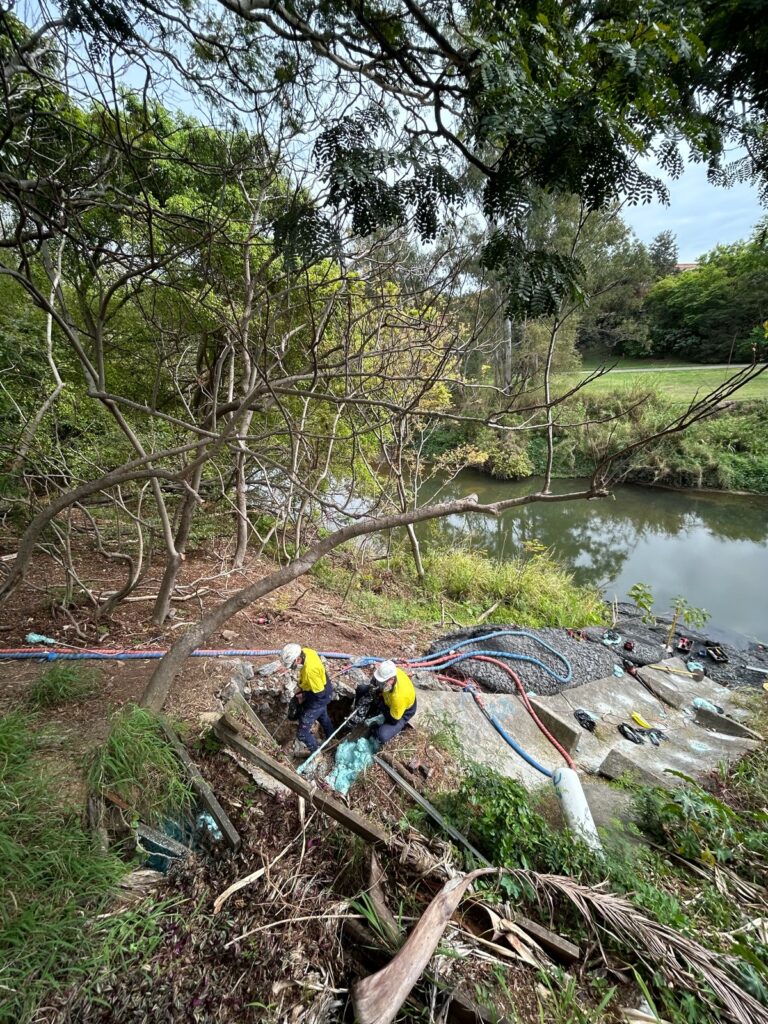
Void filling around a stormwater culvert: flood damage collapsed a 250 m culvert near Maitland NSW, leaving a sinkhole above it. While Wilmot Pipelining relined the culvert, Resinject filled the gap between the new liner and the old pipe with resin instead of cement grout, finishing in four days.
Void filling adits under a road: Resinject filled a World War II explosives chamber under a Royal National Park road overnight, before it gave way.
Sinkhole FAQs
Call 000 if anyone is at risk, your water utility for suspected leaking mains or sewers, and the local council for public land. In NSW mine subsidence districts, call Subsidence Advisory NSW on 1800 248 083. For private property, call a ground repair specialist.
There’s no flat price. Investigation, depth, access, water issues and the repair method set the cost. Resinject offers a free, no-obligation site assessment and quote.